I've always been a builder.
Long before "director" showed up on a business card, I was a kid on my family's farm in Connecticut, planting Christmas trees under the hot sun. Years later I built an app that helps people find their way around those same fields. I wrote it myself in Swift, gave it away, and it's held a five-star rating for ten seasons. That instinct never left. In every job I've had, the part I quietly guarded was the part where I'm actually making the thing.

Maple Row Farm. Where the building instinct started.
I've led design teams for a few years and I'm good at it, but the work I'm proudest of was never the org chart. It was the thoughts in the file. An agentic interaction model. The three taps I cut between a person and the answer they came for. The features I talked the team out of shipping. I think best when my hands are dirty, and that's how I like to work.
So here's what I think is happening to our craft.
The floor under UX is rising fast. Generative AI made baseline production nearly free, and the studies all point the same direction: developers ship dramatically faster, a growing share of production code is machine-written, most designers now reach for AI every week. Anyone can spin up a clean prototype or a serviceable paragraph. Producing artifacts used to be the moat. Now it's the price of entry.
And when making things gets that cheap, you don't get clarity. You get piles of AI slop. Artifacts everywhere, assumptions quietly diverging, no shared problem underneath any of it. So I stopped treating a prototype as a deliverable and started treating it as an instrument, each one is a question about how the system could potentially behave, not a picture of how it should look. The skill now is aiming all that cheap production at the questions worth asking.
Here's the tell: for all that adoption, organization-wide productivity has barely moved. The bottleneck slid downstream; into user behavior, empathy, judgment, review, integration, taste. The floor rose, but the ceiling hasn't. And the ceiling can still be one person with a defensible opinion about what good looks like. That gap is the part of the work I love.
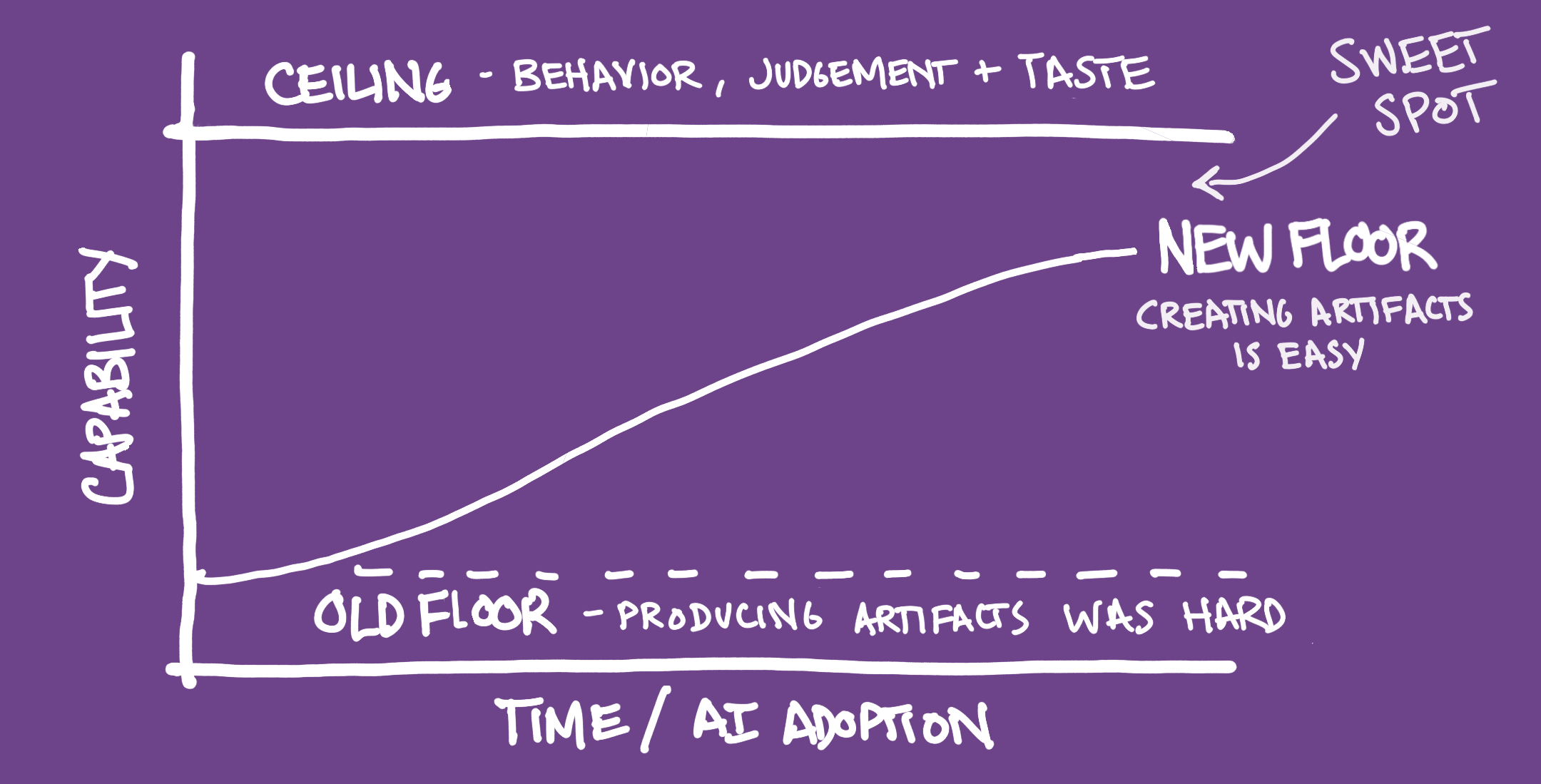
The floor rose while the ceiling didn't. What's left between them is the designers judgement which is the whole ball of wax now.
I experiment constantly. Not as a side habit, but as the way I work. Claude Code and Figma MCP take me from concept to a working prototype with no handoff, so I'm pressure-testing interaction models in days, sometimes hours, against a live design system instead of waiting weeks for a build. I design recurring agents that handle repetitive cognitive work on a schedule. And I spend real time on research and agent design review, because in an agentic product the thing you're shaping isn't a screen, it's a behavior: what the agent assumes, when it checks before acting, whether it fails out loud, how it earns a little more trust with each pass. Someone has to hold the bar on that behavior, and it should be a designer who understands both the model and the human on the other side of it.
It's also why design keeps absorbing scope. Once a designer can build, the handoff collapses. What took three roles and three weeks can take one person and an afternoon. Nobody handed us that permission. The tools just made it possible.
What I care about is covering both ends of the gap at once, like a chef who works the line and runs the pass. The speed of cranking out dishes, and the judgment of deciding which ones leave the kitchen, held by the same hands.
I've got receipts. Agentic interaction models that shipped, and a team upleveled to design the same way. Contested calls that pushed search use up 200 percent. A platform NPS that climbed from 20 to 48. A small app, built alone, that's outlasted every framework war of the past decade and still earns five stars.
I'm most at home where the ceiling matters and the bar is high. That's the work I want to keep doing.
Thanks for reading this.